Stop paying for clicks that don't convert. We engineer Google Ads campaigns that prioritize revenue over volume, applying strict guardrails to Google’s automation to capture high-intent demand.
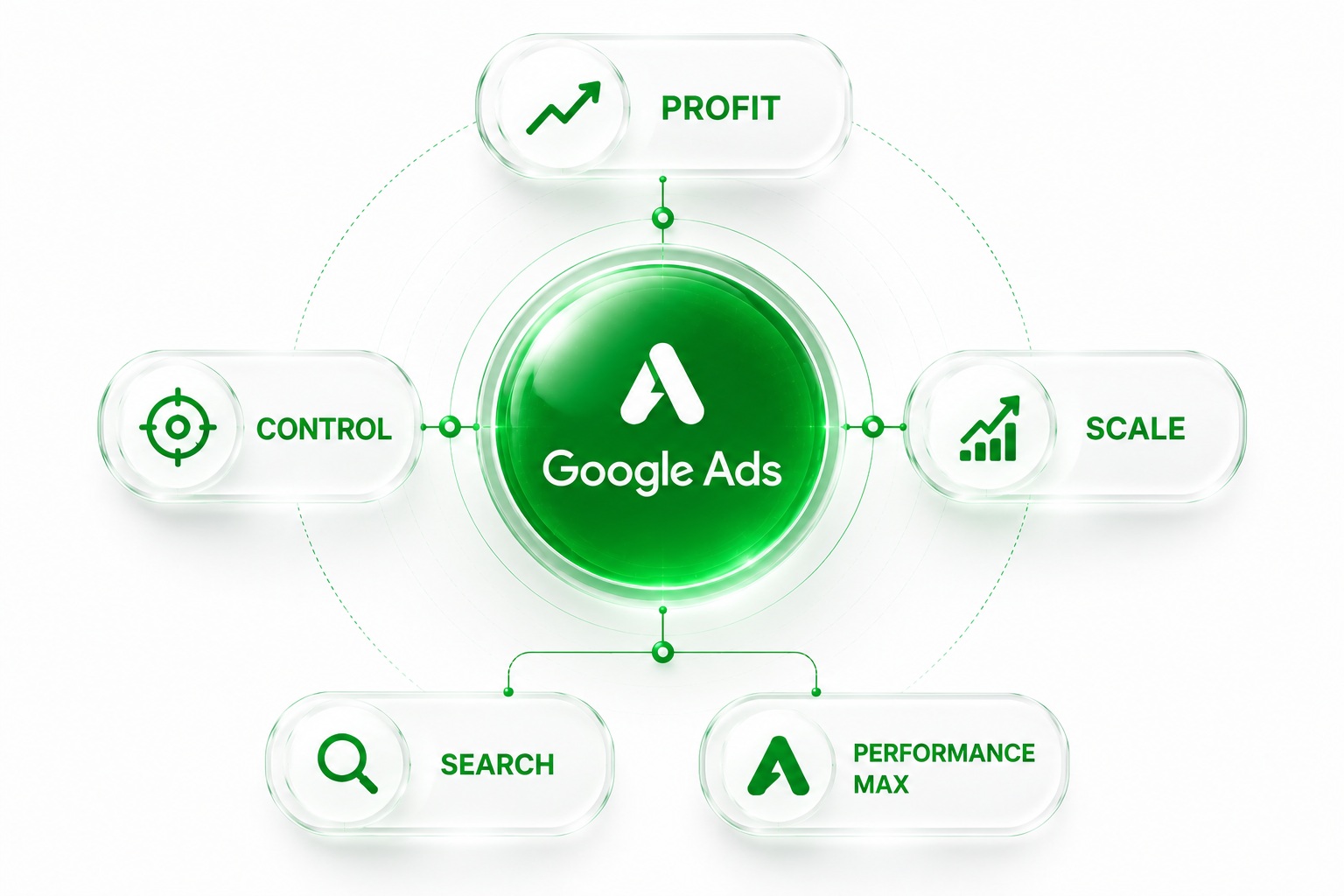
We migrate from vanity metrics (CPC/CTR) to commercial targets (tROAS, POAS).
Breaking down Performance Max "black boxes" into targeted audience signals for precise control.
Optimizing product feeds to ensure ad spend flows only to high-margin or high-converting SKUs.
Aggressive exclusion lists to prevent budget leakage on irrelevant or low-intent queries.
Aligning paid search with SEO data to reduce cannibalization and maximize total SERP real estate.
Google’s default settings are designed to spend your budget, not necessarily to generate profit. Many businesses suffer from "PMax fatigue," where automation targets low-quality inventory (like mobile apps) to claim cheap conversions.
We deploy a rigorous structuring process:
We implement server-side tracking (CAPI) and Enhanced Conversions to ensure data accuracy.
For Search, we separate high-performing exact match keywords from broad discovery terms to control costs.
We split Asset Groups by product category or service line, customizing creative assets and audience signals for each to ensure relevance.
Paid Search offers immediate feedback, but efficiency takes calibration.
Fix tracking errors, cut wasted spend on irrelevant terms, and restructure campaigns.
Cost Per Acquisition (CPA) decreases as the algorithm learns from cleaner data signals.
We incrementally increase budgets on winning segments while maintaining stable ROAS.
Transparency in a typically opaque channel.
A clear map of how campaigns, ad groups, and asset groups are organized.
Verification of pixel firing, tag health, and attribution models.
Data-backed feedback on headlines, images, and video assets needed for PMax.
A proactive exclusion list to block spammy apps and irrelevant sites.
24/7 access to your core metrics (Cost, Conversion Value, ROAS).
You don't have to choose. We often use them together. PMax covers the entire Google inventory (YouTube, Gmail, Discover, Maps), while Standard Search allows for surgical control over specific high-value keywords.