SEO Migrations & Recovery: Protect Organic Growth Through Change

Site migrations and major search updates are the highest-risk events in organic search. A replatform, redesign, domain change, or core algorithm update can erase years of compounded authority in a single deployment.

We treat migrations as controlled engineering events and approach recovery as root-cause diagnosis, protecting the revenue your organic channel already produces and rebuilding visibility when it has been lost.
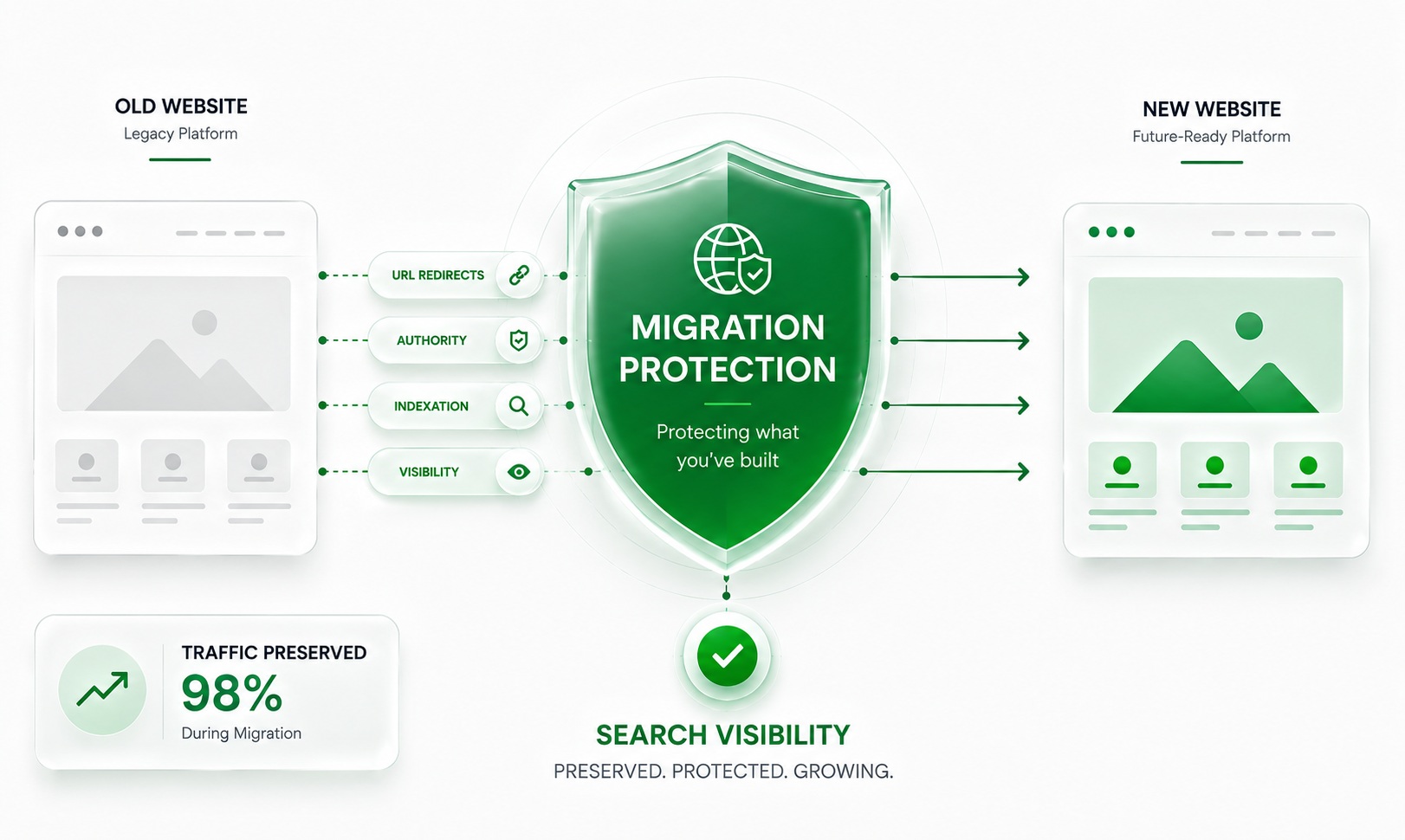
SEO Migrations & Recovery
Strategic Value

Key Strategic Outcomes

Traffic Continuity

Preserve organic sessions and revenue through replatforming, redesigns, and domain changes.

01

Ranking Recovery

Rebuild visibility lost to failed migrations or algorithm updates.

02

Risk-Controlled Launch

Reduce the probability of traffic loss before, during, and after deployment.

03

Equity Preservation

Protect existing link equity and entity signals across changing URLs.

04

Root-Cause Clarity

Isolate the actual driver of a decline instead of reacting to symptoms.

05

Revenue Protection

Map every migration decision to commercial exposure, not rankings alone.

06

The Strategic Difference

Feature
Traditional Agencies
Our Approach
Primary Goal
Launch the new site on schedule
Launch without losing organic revenue
Migration Role
SEO reviewed after development
Search continuity as a launch requirement
Redirect Logic
Bulk redirect to the homepage
URL-level mapping that preserves equity
Recovery Method
Generic "publish more content" advice
Root-cause diagnosis tied to the specific drop
Reporting
Ranking checklist
Traffic, revenue, and recovery trajectory

Deep Dive: Our Framework

The Strategic Gap & Solution

Migrations fail when they are managed as development projects with search added at the end. Most post-migration traffic loss is avoidable: it comes from broken redirect logic, dropped metadata, altered URL structures, or new templates that strip the semantic signals search engines rely on.

Recovery fails for a different reason. Teams react to the visible symptoms instead of identifying the real cause. The decline may be technical, algorithmic, or content-driven, and each of these requires a different recovery path.

Our solution treats organic performance continuity as a core deployment requirement rather than a post-launch repair. In recovery projects, we use a diagnostic methodology to identify the root cause of the decline first, then build the appropriate recovery plan based on data and evidence.

Our Methodology

1

Pre-Migration Benchmark

Record rankings, organic traffic, and indexed URLs before any change is made.

2

Redirect Architecture

Map every legacy URL to its closest live equivalent to carry equity forward.

3

Staging Validation

Verify crawlability, rendering, and structured data on staging before launch.

4

Launch-Window Monitoring

Track indexation, server errors, and traffic in real time during deployment.

5

Decline Diagnosis

Separate algorithmic impact, technical faults, and content gaps as distinct causes.

6

Prioritized Recovery

Sequence fixes by their probable effect on lost visibility and revenue.

Expected Outcomes & Timeline

01

Weeks 1 to 2 (Stabilize)

Identify critical errors, restore broken redirects, and stop further loss.

02

Months 1 to 2 (Recover)

Re-index priority URLs and restore early rankings on core terms.

03

Month 3 and beyond (Rebuild)

Visibility returns toward or above the pre-event baseline as authority recompounds.

Recovery speed depends on the cause of the decline, the scale of the loss, and the level of competition in the market.

What You Receive

Migration Risk Assessment

A pre-launch evaluation of where organic traffic is most exposed.

Redirect Mapping Blueprint

A URL-level redirect plan that preserves link equity and crawl paths.

Staging Validation Report

A pre-deployment check of crawlability, rendering, and structured data.

Traffic Loss Diagnosis

A root-cause analysis separating algorithmic, technical, and content drivers.

Recovery Roadmap

A prioritized action plan sequenced by commercial impact.

Recovery Performance Dashboard

A live view of indexation, rankings, and traffic measured against baseline.

Protect the Organic Growth You've Already Built

Whether you're planning a migration or recovering from a decline, every delay increases the cost of recovery. Work with a partner that protects your organic visibility, traffic, and revenue through change.

Book an SEO Migration & Recovery Consultation

Frequently Asked Questions

Before design and development begin. Most traffic loss is decided by choices made early, including URL structure, template architecture, and redirect logic. Involving search expertise only at launch limits the work to damage control rather than prevention.