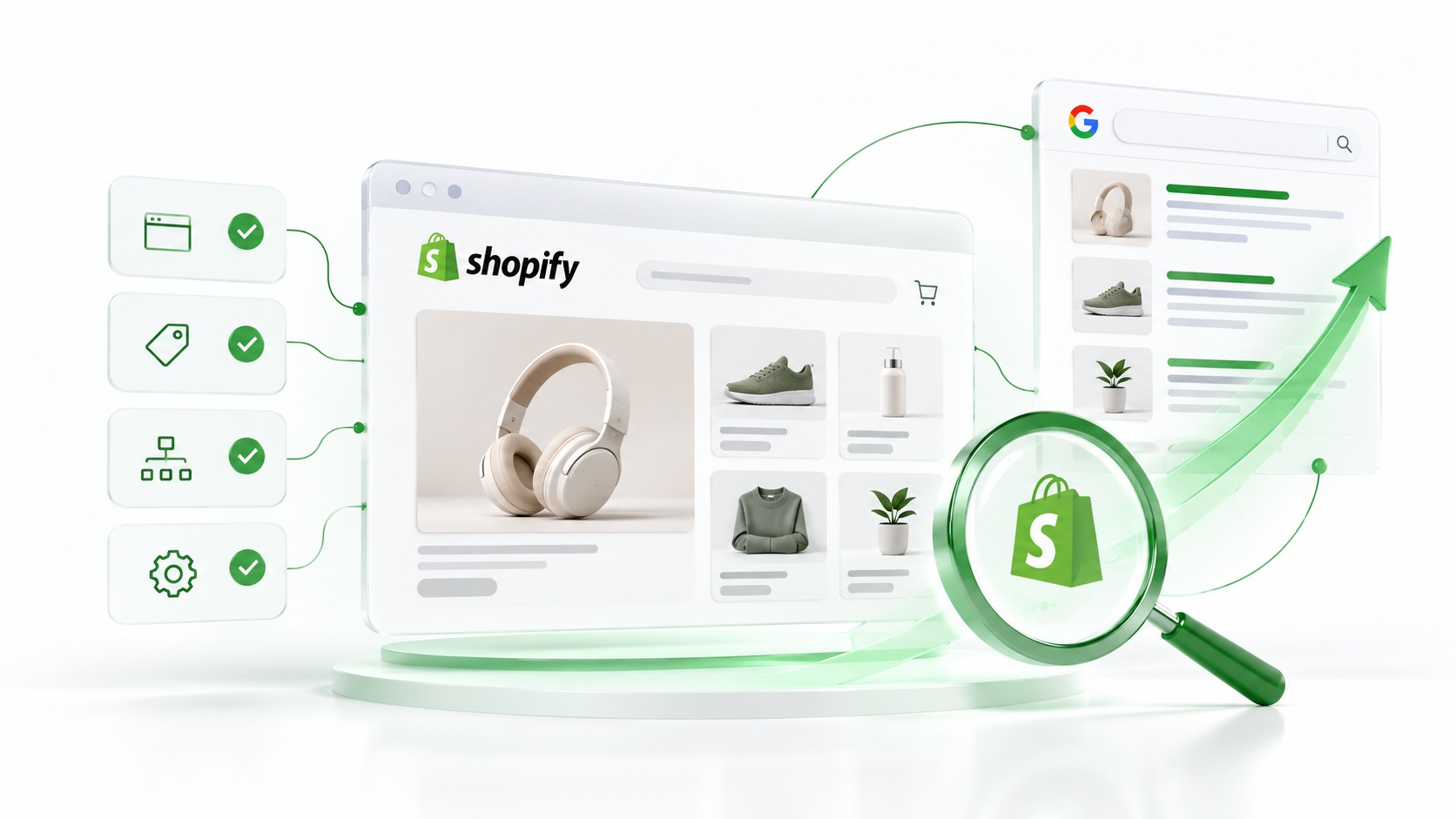
Shopify SEO Services

A Shopify store can offer great products while important products and collections remain difficult to find in search due to structure, indexation, internal linking, themes, apps, or competing URLs.

Arabia Pro provides Shopify SEO services to identify these issues and improve search access to priority products, collections, and commercial pages.

Shopify SEO Services

Key Strategic Outcomes

Better visibility for priority products and collections.

Create clearer routes for customers and search engines to reach the commercial pages that matter most.

01

Clearer decisions about which pages should appear in search.

Identify pages that should be indexed, pages that should not compete for the same purpose, and cases where similar or repeated URLs may create unclear signals.

02

Stronger alignment between page type and search intent.

Clarify when a product, collection, brand or another commercial page should answer a particular search need.

03

Safer growth as the store expands.

Consider SEO risks before new products, collections, markets, themes, apps or large groups of similar URLs multiply existing issues.

04

More useful performance evidence.

Separate what was implemented in Shopify from what changed in search performance and what later happened in conversions, sales or other commercial indicators.

05

What Makes Shopify SEO Different

Shopify SEO is not a generic SEO checklist applied to an online store. Shopify has its own catalog structure and implementation constraints. Products, collections, filters, tags, navigation, themes, apps, internal links, canonical signals and market settings can all affect which URLs search engines reach, index and understand.

The important question is not only whether general SEO best practices have been followed. It is whether the right Shopify pages are reachable, indexable and clear enough to answer the searches that matter to customers.

This service is especially relevant when:

1 Important products or collections are not gaining the expected search visibility.
2 Collection pages are weak, repetitive or poorly organized.
3 Product and collection pages compete for similar searches.
4 Filters, tags or app-generated URLs create indexation problems or repeated paths.
5 Indexation or canonical decisions are unclear.
6 Theme or app changes affect important search elements.
7 The store is expanding into new countries or languages.
8 SEO recommendations need precise implementation inside Shopify.

Some issues belong directly within Shopify SEO because they arise from the platform, its catalog or its implementation. Site-wide crawl, rendering or technical health problems may require Technical SEO. Broader product, category and commercial search strategy sits within Ecommerce SEO.

Keeping those boundaries clear allows Shopify SEO to focus on the problems that actually require platform-specific execution.

Shopify SEO Framework

We review how products, collections, menus and navigation paths are organized across the store.

The objective is to make sure important commercial pages have a clear role and can be reached through logical routes. Good Shopify architecture does not mean creating additional collections simply to target more keywords. The structure should help customers and search engines understand the relationship between products, categories, brands and buying needs.

We also consider whether the structure will remain manageable as the catalog grows. An architecture that looks logical on paper is not useful if the e-commerce team cannot maintain it consistently inside Shopify.

Products, collections, brand pages and other commercial destinations should not all perform the same search role.

We assess which page type is most suitable for each search intent. Some searches are better served by a collection where shoppers can compare options. Others require a specific product, brand page, comparison page or supporting guide before purchase.

The review looks at:

  • The role of each page.
  • How well the page matches the customer's search intent.
  • Whether its content provides useful decision-making information.
  • How the page supports the next step toward purchase.
  • Whether several URLs are competing for the same commercial purpose.

When the issue extends beyond search visibility into the on-site buying or conversion journey, SEO & CRO Integration can address that relationship without turning Shopify SEO into a broader CRO engagement.

Shopify simplifies many aspects of store management, but its implementation model also affects technical SEO decisions.

We review the platform-specific technical conditions that materially influence important store pages, including crawl access, indexation signals, canonical handling, internal links, filter or tag URLs, theme output, app-generated elements and structured data where it is relevant to the issue being investigated.

The objective is not to produce a long technical checklist. It is to determine:

  • What can be controlled directly inside Shopify.
  • What requires development or theme support.
  • What may be caused or modified by an app.
  • What needs to be validated after implementation.
  • Which technical issues directly affect search visibility.

Broader technical problems that are not specific to Shopify remain within the Technical SEO scope.

Internal links help customers and search engines understand which products and collections are important and how they relate to the rest of the catalog.

We review whether priority commercial pages receive useful internal links from navigation, collection paths, related products, content blocks and supporting resources rather than relying on weak, temporary or difficult-to-reach routes.

Indexation is reviewed in the same context.

Having more URLs indexed does not automatically create better SEO performance. A Shopify store may generate many URLs, but not every URL should become a search destination.

The practical question is whether indexed pages are useful, sufficiently distinct and aligned with a meaningful search or commercial purpose. We identify the pages that should be strengthened, the URLs whose search visibility needs greater control, and where internal linking should reinforce the store's priorities.

Shopify SEO does not mean filling product and collection pages with repetitive keyword-focused copy.

Customers need useful information before they buy, and search engines need enough context to understand what a page is about and how it differs from other pages in the store.

We review where existing pages already answer customer needs, where important information is missing and when supporting content can help users move toward the right product or collection.

Depending on the store, that can include:

  • Collection introductions.
  • Product information and descriptions.
  • Buying guides.
  • FAQs.
  • Brand or category explanations.
  • Comparison content.
  • Supporting articles or guides connected to the buying journey.

Keywords are treated as evidence of how customers search, not as phrases that must be repeated a fixed number of times.

As a Shopify store grows, SEO problems can scale with it. New products, collections, filters, tags, markets, languages, themes and repeatable page patterns can generate large numbers of URLs. Without clear planning, that growth can create repeated pages, weak search destinations, inefficient crawling or unclear page signals.

Where there is a genuine commercial reason to create many distinct pages for repeatable search patterns, Programmatic SEO may support the scalable model.

If the store is undergoing a major domain, platform, URL, theme or structural change, SEO Migrations & Recovery may be more appropriate than treating the transition as a routine Shopify adjustment.

Stores expanding across countries or languages may also require International & Multilingual SEO for the broader market and language architecture, while Shopify SEO focuses on implementing those decisions within the platform.

Strategic Difference

Dimension
Common Execution Pattern
Our Approach
Starting point
Apply a general SEO checklist to a Shopify store
Start from the actual store structure, page types and Shopify implementation constraints
Commercial pages
Optimize products and collections independently
Define how products, collections, brand pages and other commercial destinations work together according to search intent
Platform changes
Recommend SEO changes without reviewing theme, app or Shopify implementation effects
Assess recommendations within the actual store setup and verify material output after implementation
Indexation
Try to get more Shopify URLs indexed
Identify which pages deserve search visibility and how repeated or low-value URLs should be controlled
Content
Add SEO copy broadly across products and collections
Improve content where it supports customer needs, page purpose and relevant search demand
Related requirements
Pull technical, conversion, international, scaling and migration issues into one Shopify engagement
Keep Shopify SEO focused and move specialist requirements into the appropriate adjacent service when needed

What You Receive

Shopify SEO priority plan.

A clear view of the issues and opportunities that matter most to product, collection and commercial-page visibility, with a defined starting point.

Store architecture and indexation review.

Recommendations covering product-to-collection relationships, navigation, page roles, indexation decisions and canonical considerations where relevant.

Commercial-page recommendations.

Guidance for products, collections, brands and other relevant store pages based on search intent, page purpose and the information customers need before purchase.

Internal-linking and content guidance.

Practical recommendations to strengthen routes to priority pages and cover useful search demand without creating unnecessary repetition across the store.

Implementation and validation notes.

Clear separation between changes that can be handled inside Shopify, work that may need development or theme support, and checks required after implementation.

Measurement plan.

A practical way to separate implementation completion, crawl and indexation health, search performance and downstream commercial indicators.

Measurement & Evidence

Shopify SEO should not be judged by one keyword ranking or one traffic number. Useful measurement separates the stages of performance so an implementation change is not mistaken for a commercial result.

Implementation verification

Confirm that agreed changes were actually applied inside Shopify, including relevant indexation settings, canonical signals, internal links, theme output and app-related elements within scope.

Crawl & indexation

Check whether important pages can be reached and indexed as intended, and whether duplicate, repeated or low-value variants are being handled consistently.

Search performance

Track visibility, impressions, rankings, clicks and visits from organic search for relevant page groups and query themes. These metrics remain separate because each answers a different performance question.

Commercial indicators

Where reliable tracking exists, review leads, conversions, sales, pipeline and revenue separately. Indexing a page does not automatically increase sales, and a ranking improvement alone does not prove revenue growth.

When the store needs a broader and ongoing performance layer, SEO Tracking & Analytics can provide deeper reporting and interpretation.

Clarify What Is Limiting Your Shopify Store in Search

If important products or collections are not gaining the expected visibility, indexation decisions are unclear, or theme and app changes have made the source of a problem difficult to identify, Arabia Pro can review the store and determine where Shopify-specific work should begin. The consultation clarifies the problem, its commercial relevance and whether the requirement belongs within Shopify SEO or should move to a related specialist service.

Book a Shopify SEO consultation

Frequently Asked Questions

No. Catalog size is not the deciding factor. A small store may still need Shopify SEO when important pages are difficult to reach, products or collections are not indexed as intended, several URLs compete for the same purpose, or platform implementation is limiting search visibility.