Arabic SEO Services for GCC & MENA Markets

Reaching Arabic-speaking customers starts with understanding how they search, compare, and make decisions not simply translating an English website.

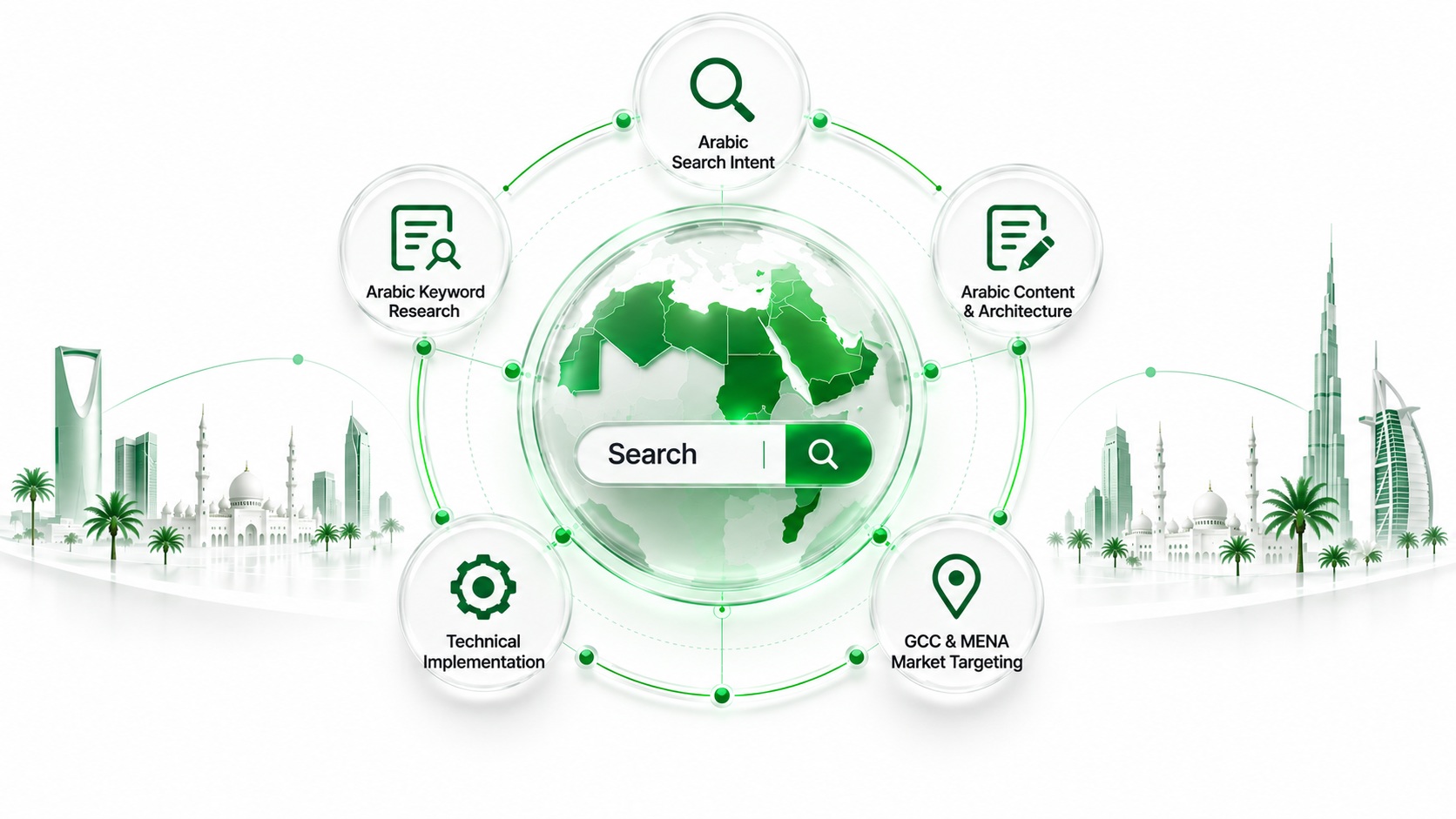
Arabia Pro builds Arabic SEO strategies around Arabic search behavior, search intent, content and page architecture, technical implementation, and the specific GCC and MENA markets your business wants to reach.
Arabic SEO Services for GCC & MENA Markets

Who This Service Is For

Arabic SEO is designed for businesses that want to build meaningful organic visibility among Arabic-speaking customers. It is particularly relevant to:

1 International companies entering GCC or MENA markets.
2 Regional businesses whose Arabic pages are translated but underperforming.
3 SaaS, B2B, e-commerce, healthcare, education, real estate, and service businesses targeting Arabic-speaking audiences.
4 Marketing teams managing multilingual websites without specialist Arabic search expertise.
5 Companies that need an Arabic search strategy rather than Arabic content translation alone.

Why Arabic SEO Requires Its Own Strategy

Having Arabic pages does not automatically make a website competitive in Arabic search. The gap often starts when the Arabic experience is built around English-first assumptions:

English keywords are translated directly into Arabic

Arabic pages replicate the structure of English pages

Market-specific terminology is overlooked

Arabic customer questions and decision journeys are not reflected

Arabic, language, and market page relationships are unclear.

For businesses operating across multiple languages, these issues can also affect the broader multilingual architecture addressed through International & Multilingual SEO. The result is a disconnect between what a business offers and how Arabic-speaking customers actually search.

Arabic SEO closes that gap by connecting:

Search Behavior → Search Intent → Pages → Content → Technical Signals → Commercial Outcomes

Arabia Pro's Arabic SEO Approach

We do not treat Arabic SEO as a translation exercise. We start with how Arabic-speaking customers search, evaluate options, and move toward commercial decisions. From there, we determine how search demand should translate into page priorities, content, information architecture, technical implementation, and market targeting.

What Arabic SEO Is Designed to Improve

Stronger Arabic Search Visibility

Increase the opportunity for important services, products, and content to appear for relevant Arabic searches.

01

Better Search Intent Alignment

Connect Arabic search demand with pages and information that match what users are actually trying to accomplish.

02

Stronger Market Relevance

Adapt terminology, content priorities, and page structures to the Arabic-speaking markets that matter commercially.

03

Clearer Multilingual Relationships

Establish clearer relationships between Arabic pages and other language versions without assuming identical search behavior or terminology.

04

More Reliable Technical Foundations

Identify technical and structural factors that may limit crawling, indexation, understanding, or visibility of Arabic pages. Where broader technical issues are involved, they can be addressed through Technical SEO.

05

Arabic SEO Framework

Arabic keyword research is only useful when the underlying intent is understood. A search may indicate that someone wants to compare providers, evaluate a solution, understand a problem, find a local business, purchase a product, or contact a company. We identify the intent first, then determine which page should satisfy it. This prevents businesses from creating Arabic pages simply because an English keyword has an Arabic equivalent.

Arabic search behavior cannot be reduced to translating an English keyword list. We study the words, phrases, variations, and commercial terminology customers actually use when searching for products, services, problems, and solutions. The analysis can account for differences between markets, industries, and customer segments. The objective is not to collect more keyword variations. It is to identify the language that reflects genuine search demand and commercial intent.

Arabic pages should support the same core business proposition as their English counterparts, but they do not necessarily need identical wording or structure. We assess how Arabic service, product, category, landing, and educational pages should be organized around Arabic search behavior and customer needs. Where new content is required, it should be developed for the Arabic audience rather than treated as line-by-line translation. For broader multilingual architecture and market targeting, Arabic SEO connects with International & Multilingual SEO.

We review the signals that help search engines understand Arabic pages, their relationships with other language versions, and the markets they are intended to serve. Depending on the website, this may include indexability, internal linking, language relationships, canonical settings, structured data, and international targeting signals. For websites where these issues form part of a wider technical challenge, Technical SEO provides the broader technical foundation. This service focuses specifically on technical elements that affect the Arabic search experience.

Arabic is not a single search market. Customers in Saudi Arabia, the UAE, Oman, Qatar, Kuwait, Egypt, and other Arabic-speaking markets may use different terminology and exhibit different search behaviors. We adapt the strategy to the markets that matter to the business. This is particularly important when one website serves multiple Arabic markets and the business needs to determine where localized terminology, content, or page structures are commercially justified. For businesses where local intent and physical locations are central to acquisition, Local SEO & Map Visibility can complement the Arabic search strategy.

Arabic SEO Across Business Models and Markets

Arabic SEO can intersect with other search requirements depending on the business model and market.

Translation-Led Arabic Website vs. Arabic SEO

Dimension
Translation-Led Arabic Website
Our Arabic SEO Approach
Strategy
Starts from the English website
Starts from Arabic search behavior
Keywords
Translates English keywords
Researches actual Arabic search terms
Content
Reuses English structure
Builds content around Arabic intent
Page Structure
Copies the English hierarchy
Evaluates structure based on Arabic demand
Market Focus
Treats Arabic mainly as a language version
Treats Arabic as a commercial search market
Technical SEO
Often limited to basic implementation
Reviews signals affecting Arabic visibility
Measurement
Focuses mainly on rankings and traffic
Connects search performance to business actions

What You Receive

A Market-Specific Arabic SEO Strategy

A strategic direction aligned with your business model, commercial objectives, and priority Arabic-speaking markets.

Search Demand & Intent Insights

A focused view of Arabic search demand, terminology, and user intent relevant to your products, services, and commercial goals.

Arabic Content & Page Recommendations

Recommendations for the pages, content, and information architecture required to address meaningful Arabic search opportunities and support the customer journey.

Technical & Language SEO Findings

Identification of technical and language factors affecting Arabic visibility, page relationships, indexation, and market targeting.

Internal Linking Recommendations

A prioritized internal-linking structure that strengthens relationships between relevant Arabic pages and supports commercially important pages.

GCC & MENA Market Recommendations

Market-specific recommendations reflecting differences in search behavior, terminology, audience needs, and commercial relevance.

Prioritized Action Plan

A practical sequence of SEO actions ranked by search opportunity, business relevance, and expected commercial impact.

Measurement Framework

A measurement approach connecting Arabic search visibility and traffic with leads, conversions, sales, or revenue where reliable attribution is available.

Measurement & Business Impact

Arabic SEO should be measured according to what the website is expected to achieve commercially. Depending on the business model, relevant metrics may include:

Arabic search visibility

Impressions from Arabic queries

Rankings for priority Arabic searches

Clicks from Arabic search

Visits to Arabic landing pages

Engagement with important Arabic pages

Leads and enquiries

Conversions

Sales and revenue where reliable tracking is available

Higher rankings alone do not demonstrate business growth. More Arabic traffic does not automatically mean more qualified demand. The objective is to determine whether increased Arabic search visibility contributes to meaningful business actions. For broader SEO performance measurement and reporting, see SEO Tracking & Analytics.

Build Arabic Search Visibility Around How Your Customers Actually Search.

If your Arabic website is primarily a translated version of your English website, there may be a gap between your content and how Arabic-speaking customers actually search. A consultation can help identify whether Arabic search represents a meaningful growth opportunity and where the highest-priority changes lie across search intent, terminology, content, page architecture, technical SEO, and market targeting.

Book a Consultation

Frequently Asked Questions

No. Translation may be part of the process, but Arabic SEO also requires search demand research, intent analysis, content planning, page architecture, technical review, and market adaptation.