Mother & Baby E-commerce: From Random SEO to a Structured Search System
01
Client Overview
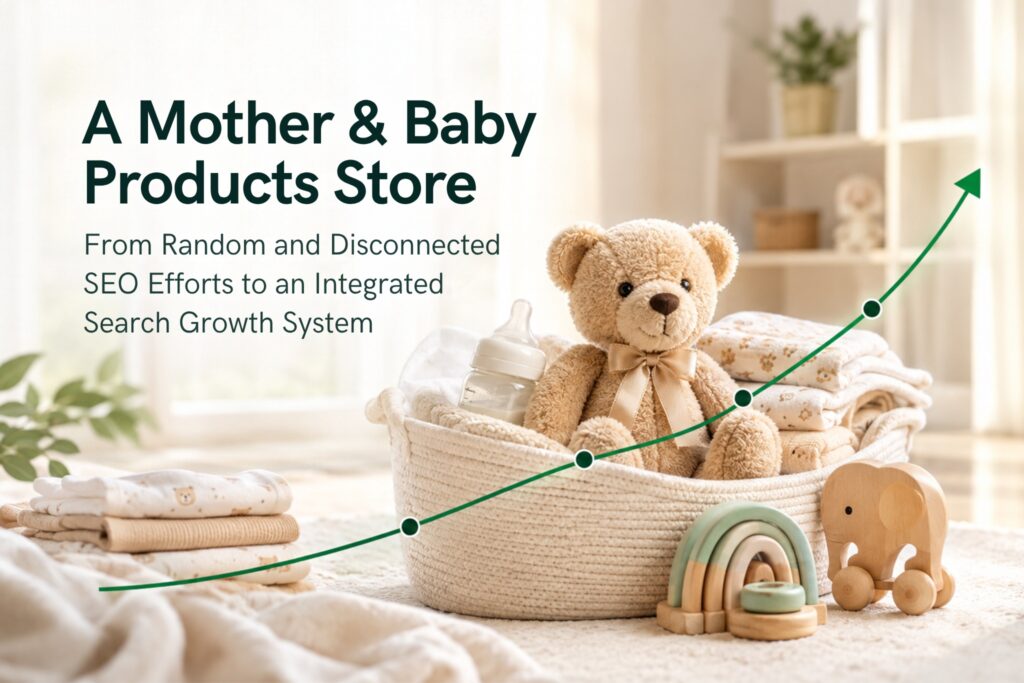
The client is an online store serving mothers and families across Qatar, operating in both Arabic and English across a broad catalogue of mother, baby, and family products. It sells into a market with clear, recurring buyer demand and a wide range of brands and product categories.
At the time of engagement, the store had genuine commercial demand but was not capturing it in organic search. The catalogue existed, the buyers existed, but the site had no search structure to connect the two, and the SEO effort in place was pointed in the wrong direction.
02
The Problem: Activity Without Structure
What was happening before
SEO effort was concentrated on activities that do not build durable e-commerce visibility, and some of it carried real risk. A team had been hired to build backlinks at volume, with no strategy or quality control, and the blog was publishing content that did not match how shoppers actually search. On top of this, the e-commerce platform generated multiple URLs for the same product on a shallow taxonomy that was not segmented around the customer journey, so link and ranking signals were diluted across duplicate and poorly structured pages. The result was constant activity with little commercial return.
Before and after
The strategic diagnosis
The core issue was a sequencing error. Effort was being spent on links and off-intent content while the store lacked the structure that actually captures e-commerce demand. The correct sequence is always the same: stop the harmful activity, fix the technical foundation and the duplicated, shallow URL structure, then build a commercial architecture of collections, brands, and products mapped to how shoppers search. Content supports that structure; it does not replace it.
03
The Strategy: A Structured E-commerce Overhaul
The work followed a deliberate sequence. You cannot build visibility on an unstructured store, and you cannot capture commercial demand without collection, product, and brand pages that mirror how shoppers search. The phases were executed in order.
Phase 1 — Reset and Technical Foundation
Foundation
The first move was to stop the activity that was adding risk and noise, then make the store technically sound.
- Paused the random, unstructured backlink building to remove risk and wasted spend
- Stopped off-intent blog publishing that was not matching search demand
- Ran a technical audit covering crawling, indexing, performance, and the site’s link structure
- Resolved the platform’s duplicate product URLs and shallow taxonomy, segmenting the structure around the customer journey
- Established a clean foundation before any structural or content work began
Phase 2 — Catalogue Architecture and Keyword Strategy
Architecture
With the foundation clean, the focus shifted to the core SEO asset in e-commerce: the commercial page architecture. The catalogue was inventoried and structured around real demand.
- Inventoried the available products and grouped them into collections based on real search demand and what the store stocks
- Built dedicated brand collection pages so each stocked brand has its own optimized landing page for brand-led searches
- Ran Qatar-market keyword research and split terms by search intent
- Mapped each keyword cluster to the single page type built to satisfy it
- Aligned collection naming and structure with the language shoppers actually use in Arabic and English
Phase 3 — Money-Page Optimization and Journey Content
Optimization
With structure and intent defined, the pages that drive the store were optimized in a deliberate order: the commercial landing pages first, then the product layer on an ongoing basis.
- Optimized the collection and brand collection pages first, targeting intent-matched keywords and adding content that reinforces buying intent
- Then optimized products on a monthly basis through keyword research and improved product descriptions matched to searcher intent
- Prioritized the pages closest to purchase, where visibility has direct business value
- Organized informational keywords into related content topics covering the full customer journey, supporting rather than competing with the commercial pages
Phase 4 — Structured FAQs for AI Search Visibility
Ongoing
To keep the store on a strong technical and content base as search shifts toward AI-powered answers, structured FAQs were added across the three commercial page types, tailored to each type and to where the shopper is in the journey.
- Added FAQs to category, brand, and product pages, matched to the intent and role of each page type
- Wrote answers to the real questions shoppers ask at each stage, from research to purchase
- Structured the content to be clear, extractable, and citable, so it is legible to AI-powered search and answer engines
- Strengthened topical coverage on the commercial pages without diluting their buying intent
The strategic sequence — why order matters
| # | Phase | What it achieves |
|---|---|---|
| 1 | Reset harmful activity | Remove risk from random links and clear wasted, off-intent effort |
| 2 | Fix technical foundation | Make all pages crawlable, indexable, and fast |
| 3 | Build catalogue architecture | Create collection and brand pages aligned with real demand |
| 4 | Optimize money pages and map intent | Match collections, brands, and products to how shoppers search |
| 5 | Add structured FAQs | Keep pages answerable and citable for AI-powered search |
04
Results (Qatar Market)
All figures are Google Search Console data filtered to Qatar, the store’s commercial market, tracked monthly from March 2023 to July 2026. This is the durable, home-market view, and each figure is dated to its window.
Organic performance, full dataset (Mar 2023 to Jul 2026)
| Metric | Before (Mar 2023) | Latest (Jul 2026) | Growth |
|---|---|---|---|
| Organic Clicks (Qatar) | 2.74K / month | 13.5K / month | +393% |
| Impressions (Qatar) | 25.3K / month | 315K / month | +1,145% |
| Average Position (Qatar) | 8.3 | 5.5 | +33.7% |
| Clicks YoY (March) | 2.74K (Mar ’23) | 13.4K (Mar ’26) | +389% |
Peak monthly clicks reached 13.7K in April 2026. Qatar Search Console data.
Qatar organic clicks per month
Qatar organic impressions per month
Growth narrative
2023 (Reset and Foundation): After the random activity was stopped and technical issues fixed, Qatar clicks grew steadily from 2.74K in March to about 4.1K by December as the new structure began to index.
2024 (Architecture Indexing): As collections and brand pages took hold, Qatar clicks reached about 6.3K per month by December and impressions climbed past 100K, reflecting far broader visibility across the store’s demand.
2025 to 2026 (Compound Growth): With the structure mature, Qatar clicks compounded to about 9.4K per month by December 2025 and 13.5K by July 2026, impressions reached 315K, and average position improved to a best of 5.5.
An honest note on CTR
Average CTR in Qatar fell from about 10.8% to about 4.3% over the period. This is expected and healthy at this stage: impressions grew more than tenfold as the store expanded into broad category demand, which naturally lowers average CTR while total clicks keep rising.
Sustained monthly growth across Google’s algorithm updates
The most important signal in this dataset is not a single peak. It is the direction over time. More than three years after the work began, and after repeated Google algorithm updates across 2023, 2024, 2025, and 2026, the store is still in a growth phase rather than a plateau or decline. This is the behavior of visibility built on correct, guideline-aligned structure rather than on shortcuts that updates tend to erase.
Month to month, the line is not perfectly straight, and it is not meant to be. Individual months rise and dip with seasonality and with each Google update. What matters is that the trend across years is consistently upward, and that every year-over-year comparison is positive.
| Year | Avg. clicks / month (Qatar) | Growth vs previous year |
|---|---|---|
| 2023 | 3,622 | Baseline |
| 2024 | 5,996 | +66% |
| 2025 | 9,013 | +50% |
| 2026 (to Jul) | 12,321 | +37% |
Why this matters
Every year-over-year comparison in the dataset is positive, with same-month growth ranging from about 35% to over 90% even as Google shipped multiple core and other updates. Structured, guideline-aligned SEO is what allows a site to keep compounding through those updates instead of being reset by them. This is a durable growth curve, not a one-time spike.
05
Key Insights
1
In e-commerce, collections are the SEO product
The highest-leverage work was structuring the catalogue into demand-based collections, supported by dedicated brand collection pages. Category and brand pages are where commercial search converts, so building the right ones around real demand and stock drove the growth.
2
Stop harmful activity before building
Random link building and off-intent blogging were removed first. Clearing risk and wasted effort was a prerequisite for compounding, not an afterthought.
3
Intent mapping prevents a store from competing with itself
Mapping commercial, transactional, brand, and informational intent to collections, products, brand pages, and content kept each page focused and stopped cannibalization across a large catalogue.
4
Collections and products are the commercial core
Prioritizing the pages that actually sell, collections, products, and brands, is what turned catalogue structure into commercial visibility rather than incidental traffic.
5
Judge the commercial market, not vanity totals
Filtering to Qatar isolates the traffic with real business value and gives a truer read than blended, all-market numbers.
6
A structured store is also an AI-ready store
Because growth was built on clean structure, intent-mapped pages, and, most recently, page-appropriate FAQs, the same foundation that compounds in traditional search also makes the store legible and citable to AI-powered discovery. Structural SEO is delayed, then compounds, in both.
7
Correct SEO keeps growing through Google updates
More than three years in, the store is still growing, with every year-over-year month positive across multiple Google updates. Guideline-aligned structure is what survives algorithm changes; shortcuts are what those changes remove.
06
Is This Sustainable — And Can It Be Repeated?
The results are built on structure, not shortcuts
Every growth driver here is durable: a clean technical foundation, collections and brand pages built around real demand, and product content aligned with how shoppers search. There are no rankings built on manipulated links or thin content. Foundations like these compound: the longer they run, the stronger the store’s topical depth and authority become.
Correct SEO keeps growing through Google updates. Guideline-aligned structure is what survives algorithm changes; shortcuts are what those changes remove.
The methodology transfers to other online stores
The sequence, reset harmful activity, fix technical, build catalogue architecture, then optimize money pages and map intent, is not specific to one store. What changes is the catalogue, the brand set, and the local search language. The strategic logic stays identical.
| Store Type | Common Problem | Recommended Approach |
|---|---|---|
| General & Multi-Category Stores | Flat structure, collections not built around demand | Rebuild collection and brand architecture from search demand and stock |
| Single-Category Stores | Products competing for the same head terms | Segment collections and map each to a distinct intent |
| Catalogue-Heavy Stores | Large numbers of URLs crawled inefficiently | Technical audit, crawl control, and prioritized money pages |
| Stores Relying on Random Links | Risk and wasted spend, no ranking gain | Stop unvetted link building, rebuild on structure and intent |
| Bilingual / Regional Stores | Weak Arabic and English demand capture | Arabic-first keyword mapping and market-specific collections |
What makes a store a strong candidate for this methodology
- The store has real commercial demand its structure is failing to capture
- Current organic performance does not reflect the catalogue’s actual market potential
- Collections and brands are not organized around how shoppers search
- SEO effort is going into random links or off-intent content instead of structure
- The store operates in Arabic, bilingual, or a regional market where generic templates fail
Proven Process
A tested sequence applied across e-commerce: reset, fix, structure, optimize. Structured diagnosis, prioritized execution, measurable milestones.
Market Expertise
Deep experience in Arabic-language SEO and the Qatar and Gulf market. We understand how shoppers search and how to build catalogue architecture that captures that demand.
Structural Depth
From technical audits to collection and brand architecture and intent mapping, we handle the structural layer that most agencies skip.
Long-Term Thinking
We build for compounding results, not quick wins. Every deliverable is designed to stay effective as search algorithms evolve.
07
Services Delivered
URL Structure & Duplication Fixes
Crawl & Indexation Fixes
Site Performance
E-commerce SEO
Catalogue Inventory
Collection Architecture
Brand Collection Pages
Qatar Keyword Research
Search Intent Mapping
Collection & Brand Optimization
Monthly Product Optimization
Structured FAQs for AI Search
Improving e-commerce store visibility
Journey Content Strategy
Arabic & Bilingual SEOMonthly Qatar Performance Tracking
08
Data Notes
- All performance figures are Google Search Console data filtered to Qatar, tracked monthly from March 2023 to July 2026, and dated to their windows in the Results section
- This case study reports the Qatar home market, the store’s commercial market, rather than blended all-market totals
- Average CTR declined as impressions scaled into broad category demand; this is expected while total clicks continue to rise, and is stated openly in the Results section
- Site-wide milestone figures are all-market totals over the past 28 days and are included only as directional context